


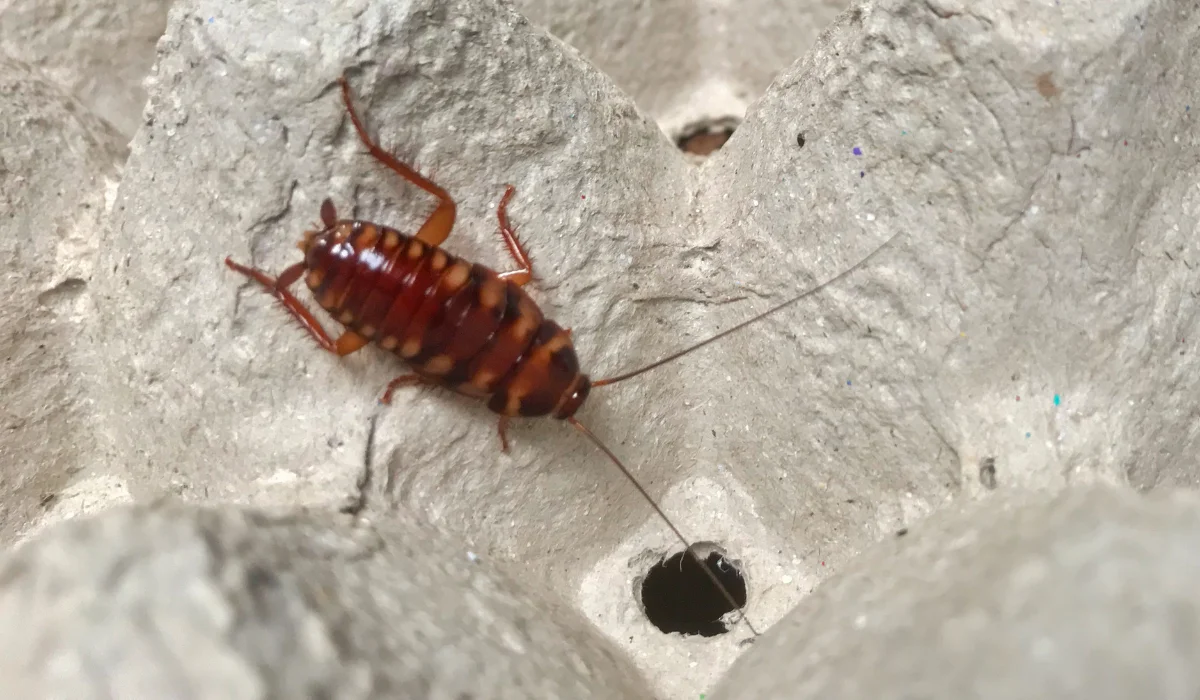
Brown-banded and German cockroaches are both small, tan-to-brown roaches that can establish populations inside Louisiana buildings. The easiest way to tell them apart is to look at their markings and where you keep finding them.
German cockroaches have two dark, parallel stripes on the area directly behind the head and favor tight, warm locations near food and moisture. Brown-banded cockroaches have noticeable bands across the abdomen and are more likely to turn up in warm, relatively dry areas, including upper cabinets, furniture, ceilings, and electronics. LSU AgCenter identifies both as cockroaches closely associated with human structures.
That distinction matters because the two species can be distributed very differently throughout a home. Finding the correct hiding areas is a major part of getting the infestation under control.
Brown-Banded vs German Cockroach: Quick Comparison
| Feature | Brown-Banded Cockroach | German Cockroach |
|---|---|---|
| Adult size | About 10-14 mm, roughly 1/2 inch | About 13-16 mm, roughly 1/2 to 5/8 inch |
| Main marking | Two darker horizontal bands across the abdomen; especially visible on nymphs and males | Two dark parallel stripes immediately behind the head |
| Preferred conditions | Warm and relatively dry | Warm, humid, and close to food and water |
| Common locations | Upper cabinets, furniture, electronics, behind pictures, ceilings, dry pantries | Kitchens, bathrooms, under sinks, cabinets, appliances, food-storage areas |
| Distribution indoors | Can be scattered throughout multiple rooms | Often concentrated around kitchens, bathrooms, and other favorable harborages |
| Egg-case behavior | Female carries the case briefly, then attaches it to a protected surface | Female typically carries the egg case until close to hatching |
| Adult flight | Males can fly | Adults are poor fliers |
| Inspection priority | Look high, dry, warm, and beyond the kitchen | Concentrate on food, water, heat, appliances, and tight crevices |
These differences are more useful than color alone. Both species are small and brown enough to be confused during a quick sighting.
How To Identify A Brown-Banded Cockroach
Adult brown-banded cockroaches are light brown to tan and about 10 to 14 millimeters long. Their name comes from the darker horizontal bands across the abdomen. The bands are particularly noticeable in nymphs and adult males.
Males have wings extending over the abdomen and can fly. Females have broader abdomens and shorter wings.
One of the most useful identification clues is where you find them.
Brown-banded cockroaches prefer warmer, drier locations than many other household cockroaches. LSU AgCenter lists places such as motors in electronics, stoves, microwaves, cabinets, pantries, behind pictures, and ceilings among their common harborages. They are sometimes called “furniture roaches” because of their tendency to infest furnishings and areas away from obvious water sources.
That means checking only beneath the kitchen sink can miss much of a brown-banded infestation.
How To Identify A German Cockroach
German cockroaches are usually light to dark brown and measure about 13 to 16 millimeters as adults.
The clearest adult marking is a pair of dark parallel stripes on the pronotum, the shield-like section directly behind the head. Nymphs are darker and do not have developed wings.
German cockroaches prefer tight, dark, warm areas with readily available food and moisture. Kitchens, bathrooms, pantries, cabinets, under-sink areas, and spaces around appliances are common locations.
LSU AgCenter also notes that German cockroaches are poor fliers and are far more likely to be encountered living indoors than the similar-looking Asian cockroach. (LSU AgCenter’s German cockroach guide)
If you repeatedly see small tan roaches around a refrigerator, dishwasher, sink, or kitchen cabinets, German cockroaches should be high on the list of possibilities.
Where Should You Look For Each Cockroach?
Looking in the right places is especially important because brown-banded cockroaches may be scattered well beyond kitchens and bathrooms.
| Area To Inspect | Brown-Banded Cockroach | German Cockroach |
| Under sinks | Possible, but not their strongest preference | Common inspection area |
| Behind refrigerator or dishwasher | Possible around warm components | Very common harborage |
| Upper kitchen cabinets | Common | Possible |
| Dry pantry shelving | Common | Common when food is available |
| Electronics and appliances | Especially important because of warmth | Possible, particularly kitchen appliances |
| Behind pictures and wall decorations | Strong brown-banded clue | Less typical |
| Furniture | Important inspection location | Less characteristic |
| Ceilings and high wall areas | Brown-banded roaches may occur here | Less typical |
| Bathroom cabinets | Possible | Common where warmth and moisture are available |
| Multiple rooms away from food | More consistent with brown-banded activity | Less characteristic of a localized German infestation |
LSU AgCenter specifically recommends inspecting the entire premises for brown-banded cockroaches because individuals can be dispersed throughout a building. Glue boards can also help determine which areas are active.
A Major Difference: Their Egg Cases
Egg cases can provide another identification clue.
Female brown-banded cockroaches carry an egg case, called an ootheca, for only a short period before attaching it to a protected surface. Those cases may turn up on furniture, walls, ceilings, or other sheltered objects.
German cockroach females behave differently. They carry their egg cases until shortly before the young hatch. LSU AgCenter reports that a German cockroach ootheca commonly contains about 30 to 40 eggs.
This reproductive pattern is one reason German cockroach populations can become difficult to manage once they are established indoors.
How Brown-Banded Cockroach Infestations Spread
Brown-banded cockroaches depend heavily on human structures and can be transported with infested belongings.
Furniture, appliances, electronics, boxes, and other items moved between buildings can potentially carry cockroaches or attached egg cases into a new location.
Once inside, brown-banded cockroaches do not necessarily stay near the kitchen. They may spread into bedrooms, living rooms, offices, closets, upper cabinets, and other warm portions of the structure.
That wider distribution is one of the most important lessons from the original brown-banded control article: inspection cannot stop at the obvious food and water areas.
How German Cockroach Infestations Spread
German cockroaches are also closely associated with people and indoor structures.
They may be transported in boxes, bags, appliances, furniture, or other belongings, then establish themselves where heat, food, water, and shelter are readily available.
Once established, German cockroaches commonly concentrate around kitchen and bathroom harborages. Small gaps beside cabinets, spaces under appliances, plumbing penetrations, and similar protected areas can hold populations that are easy to miss during casual cleaning.
LaJaunie’s broader guide to cockroaches in Louisiana covers German, brown-banded, American, Asian, smoky brown, and other species homeowners may encounter locally.
Signs Of A Brown-Banded Or German Cockroach Infestation
Seeing a live cockroach is useful evidence, but other signs can help determine whether the insect is simply an isolated sighting or part of a reproducing indoor population.
Look for:
- live adults or nymphs
- egg cases
- cast skins from developing nymphs
- small dark droppings around harborages
- repeated nighttime activity
- several cockroaches of different sizes
- recurring activity in the same cabinets, furniture, appliances, or rooms
With brown-banded cockroaches, expand the inspection vertically and into rooms where you might not normally look for roaches.
With German cockroaches, pay close attention to cracks and protected areas near food preparation, plumbing, appliances, and moisture.
Are Brown-Banded And German Cockroaches A Health Concern?
Cockroaches inside occupied structures are more than an identification nuisance.
LSU AgCenter describes cockroaches as a public-health concern because they can pick up microorganisms in unsanitary environments and deposit them elsewhere. Cockroach proteins and debris can also contribute to allergen exposure.
German cockroaches are particularly well documented in this respect. They move between food areas and unsanitary locations, which can result in mechanical transfer of microorganisms. Their fecal material and shed exoskeletons can also contribute to indoor allergen exposure.
The practical response is to address an established indoor population rather than simply killing the individual roaches you happen to see.
How To Get Rid Of Brown-Banded And German Cockroaches
The first step is correct identification. A treatment concentrated beneath sinks may miss a brown-banded population living in upper cabinets, furniture, or electronics, while a German cockroach problem may require intensive attention to kitchen and bathroom harborages.
1. Inspect Before You Treat
Brown-banded cockroaches require an especially broad inspection.
LSU AgCenter advises that no rooms be left uninspected when brown-banded cockroaches are present because the population can be scattered throughout the structure. Look for live insects, egg cases, cast skins, and fecal material.
For German cockroaches, concentrate first on areas with:
- food
- water
- warmth
- appliances
- cracks and crevices
- cabinet voids
- plumbing penetrations
Monitoring traps can help show where activity is concentrated.
2. Reduce Food Sources
Clean crumbs, grease, spilled food, and residues from surfaces and hidden spaces.
Store dry foods in closed containers, avoid leaving pet food exposed overnight, wash dishes regularly, and keep trash containers closed.
Pay particular attention to food residue underneath and beside appliances. Cleaning the visible countertop while leaving grease or crumbs beneath a stove does little to change the conditions in a nearby cockroach harborage.
3. Address Water And Moisture
Repair leaking plumbing, dripping faucets, and other unnecessary moisture sources.
This step is particularly useful for German cockroaches because of their preference for warm, humid harborages near food and water.
Brown-banded cockroaches tolerate relatively drier indoor areas, so eliminating water alone will not address their wider distribution.
4. Reduce Hiding Places
Cockroaches exploit narrow protected spaces.
Reduce unnecessary cardboard and clutter, and inspect cracks around cabinets, molding, pipes, furniture, and other potential harborages.
For brown-banded cockroaches, remember to inspect above eye level and around objects that generate heat.
5. Use Targeted Control Rather Than Treating Every Surface
Cockroach control works better when treatment is directed toward the actual harborages.
Baits are one established cockroach-control option. LSU AgCenter notes that bait placement is most effective in areas where cockroaches hide or travel during nighttime activity.
Always follow the pesticide label. Avoid assuming that applying more product or spraying every visible surface will produce better control.
How The Control Priorities Differ
| Control Priority | Brown-Banded Cockroach | German Cockroach |
| Inspection scope | Inspect the entire building, including upper and dry areas | Concentrate heavily on kitchens, bathrooms, appliances, food, and moisture |
| Monitoring | Place monitors throughout suspected rooms and near furnishings | Focus monitors around known kitchen and bathroom harborages |
| Sanitation | Important because food still supports populations | Especially important around kitchens and food preparation areas |
| Moisture correction | Helpful, but may not remove their preferred dry harborages | Major part of reducing favorable conditions |
| Hiding places | Inspect furniture, high cabinets, electronics, pictures, and ceilings | Inspect cracks, cabinets, appliances, plumbing, and nearby voids |
| Bait placement | Must reach scattered harborages rather than only floor level | Concentrate small placements near active harborages |
| Follow-up | Reinspect multiple rooms for continuing activity | Monitor reproduction and activity around primary indoor harborages |
| Professional priority | Useful when the distribution is difficult to locate or control | Particularly useful for an established indoor breeding population |
The products used for the two species may overlap, but where the treatment is placed and how thoroughly the structure is inspected can differ substantially. LSU AgCenter specifically notes that insecticides and baits used against German cockroaches can also be effective against brown-banded cockroaches, while emphasizing the broader inspection required for brown-banded infestations.
What About Boric Acid, Dusts, And Roach Sprays?
The original brown-banded article recommends gel baits, dusts, and insect growth regulators. Those tools can have a role, but this is an area where product choice and placement matter.
A pesticide should only be used for a site and pest listed on its label, and the label directions should determine how and where it is applied.
For homeowners, the larger lesson is that finding the harborages comes before choosing the treatment.
Randomly treating baseboards may overlook brown-banded cockroaches several feet above the floor. Broad applications can also miss German cockroaches tucked deep around cabinets and appliances.
Professional treatment can target those locations based on inspection findings.
How To Prevent Brown-Banded And German Cockroaches
Prevention is easier when you think about what both species need and how they are transported.
Check Items Before Bringing Them Inside
Inspect used furniture, appliances, electronics, boxes, and other items before moving them into the home.
This is particularly relevant to brown-banded cockroaches because egg cases may be attached to furnishings or other protected surfaces.
Seal Cracks And Crevices
Seal gaps around:
- plumbing penetrations
- cabinets
- molding
- utility lines
- doors
- windows
- wall penetrations
Sealing does not eliminate an existing indoor population, but it can reduce movement between harborages and limit some routes into or through the structure.
Keep Food Areas Clean
Store food properly, remove crumbs and grease, clean underneath appliances, and empty trash regularly.
Sanitation alone may not eliminate an established infestation, but it removes competing food sources and makes other control measures easier to implement.
Continue Monitoring After Activity Drops
Do not assume the problem is finished because you stop seeing adult roaches for a few days.
Continue checking monitors and known harborages for nymphs, egg cases, droppings, or other activity.
When To Call A Professional
Professional help becomes especially useful when:
- cockroaches appear repeatedly
- you find adults and nymphs together
- egg cases are present
- activity is occurring in several rooms
- brown-banded cockroaches appear scattered throughout furniture or high areas
- German cockroaches continue appearing around kitchens or appliances
- previous control attempts have not resolved the problem
- you cannot confidently identify the species
LaJaunie’s current cockroach control service distinguishes German cockroach treatment from its approach to non-German species. The company’s service information describes inspection, targeted treatment, and different control considerations depending on the cockroach involved.
That distinction is important. German cockroaches and brown-banded cockroaches can look similar, but the location and distribution of the infestation may call for a different inspection strategy.
Get Help With Cockroaches In Your Louisiana Home
The fastest way to distinguish a brown-banded cockroach from a German cockroach is to combine markings with location. Two dark stripes behind the head and repeated activity around kitchens or bathrooms point more strongly toward German cockroaches. Banded abdomens combined with activity in upper, warm, relatively dry areas point more strongly toward brown-banded cockroaches.
Once either species establishes itself indoors, finding the full extent of the infestation matters more than treating the individual roaches you see.
If cockroach activity continues in your home, contact LaJaunie’s Pest Control to have the problem identified and discuss the appropriate cockroach-control option for your property.
Frequently Asked Questions
What Is The Main Difference Between A Brown-Banded And German Cockroach?
Look at the markings and location. Brown-banded cockroaches have bands across the abdomen and favor warm, relatively dry locations, often higher in rooms or around furniture and electronics. German cockroaches have two dark stripes behind the head and typically concentrate near food, heat, and moisture.
Are Brown-Banded Cockroaches Common In Louisiana?
Brown-banded cockroaches occur throughout the southern United States and can infest homes and other structures. LSU AgCenter identifies the species as one of the cockroaches dependent on human structures for survival.
Do Brown-Banded Cockroaches Live In Kitchens?
They can, especially in warm cabinets, pantries, appliances, and electronics. Unlike German cockroaches, however, they are also likely to occur in comparatively dry rooms and locations away from sinks and other water sources.
Why Do I Keep Finding Brown-Banded Cockroaches Up High?
Their preference for warm, dry locations can lead them to upper cabinets, behind pictures, ceilings, furniture, and warm electronic equipment. That is why an inspection limited to floors and plumbing areas can miss part of an infestation.
Which Is Harder To Control, Brown-Banded Or German Cockroaches?
Both can become established indoors. German cockroaches are well known for rapid indoor reproduction, while brown-banded cockroaches can be difficult to locate because they may be scattered throughout a building. Accurate identification and inspection determine the appropriate response.